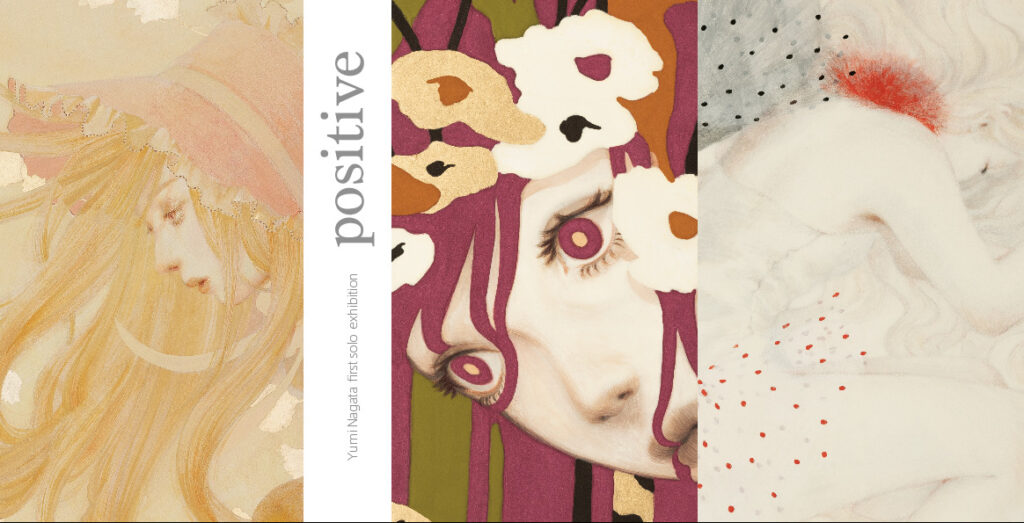
This time, biscuit gallery will be holding a solo exhibition “positive” by Yumi Nagata from September 9 to September 19.
Using girl representation developed in Japanese art and subculture as a starting point, we introduce Yumi Nagata, who straightforwardly and fearlessly reflects themes such as “loving/being loved,” “the self that depicts girls and the self that denies it,” “desire for transformation,” and “desire for recognition” into the world of contemporary painting. This marks her first solo exhibition.
At the venue, 35 new paintings will be displayed across 3 floors, each with thematic settings of “positive,” “neutral,” and “negative.” Through the works displayed on each floor, the artist projects “myself drawing girls” onto the space, with the aim of sharing and examining Nagata’s own relationship with contemporary painting.
Yumi Nagata was born in Tokyo in 1997. She graduated from Tamabi University’s Department of Painting, Japanese Painting Specialization in 2021 and is currently based in Tokyo. While her work at first glance appears to follow the tradition of Japanese painting in Japanese art—depicting girls in an aestheticized or caricatured manner—what lies behind it is what she herself describes as: “animation, manga, and the ‘girls’ I have drawn in my Japanese painting, once entering the world of contemporary art, seemed to be motifs that tend to be avoided.” She consistently confronts the treatment of the girl as a motif in the painting scene and its reception, while facing head-on how her cultural background and art-historical context can be connected—specifically through the tension between “the self that wants to paint ‘girls’ and the self that denies it.”
As Nagata states, “If I were to paint my work as painting in the contemporary sense, surely the regulatory context of ‘it must be like this’ would somehow arise,” at times she stands between “the behavior that contemporary painting should embody” and the starkly sincere emotion of “painting girls” that she has harbored since childhood, continuing to create while bewildered by the distance from its artistic dramaturgy. When we observe her own issues from a broader perspective, there emerges a narrative that could run through her generation of artists—namely, as a generation following Japanese art trends like Superflat, she naturally accepts the subculture and net culture that forms the foundation of her being, and there is a question common to her generation: how to newly materialize these cultures into works and historicize them through what methods and theories, having accepted these cultures in their establishment phase rather than their emergence as something natural.
Regarding the works in this exhibition, Nagata names them the ‘layer’ series, a double meaning title taken from both the unique layered texture created by the mineral pigments she uses and “layer,” slang for cosplayers. Nagata states that the “girls depicted” are her own alter egos/avatars and a kind of self-portrait. The spirit of substitution, or the desire for transformation to become a beloved existence, is also what makes her work distinctive. Girls adorned sometimes with headpieces, sometimes rendered in deformed proportions, sometimes dressed in bizarre costumes, and sometimes in goth subculture attire, standing in the frame of a place removed from reality, may appear to be a monologue of Nagata’s personal world and its narrative. Nevertheless, if we again align this with her generation, for those of her generation for whom animation and manga were naturally present, narrative communication is a more native method than frankly speaking of something, demonstrating that storytelling-based communication is their native language. Through this, we can discern the self-referentiality common to that generation, and the generational manner of communication and self-consciousness of “wanting to be loved/not wanting to be disliked.”
That is precisely why Nagata’s work, while certainly comprehensively grasping a certain genealogy of Japanese art, does not serve art history so much as it presents works that share the body temperature of the world as she experiences it—as narrative (=character)—connecting as Felix Gonzalez-Torres once shared the sorrow of losing his partner with viewers, and thereby presenting methods for responding to contemporary existence and the very act of living as it flows without direction. And this is clearly a testimony of one who observes the times from within, and it seems that there lies an exploration and resistance of what her generation can achieve in contemporary art today.
-Biography-
Born in Tokyo in 1997
Graduated from Tamabi University’s Department of Painting, Japanese Painting Specialization in 2021
Group Exhibitions
2020
“Beautiful Women Paintings Exhibition -Reiwa-” Takashimaya Yokohama 7F Art Gallery
2019
“Self-Portrait Exhibition 2019 by Artists Recommended by Fuyuhiko Yamamoto” gallery ARK Yokohama
Awards
2019
Ishimoto Masashi Japanese Painting Grand Prize Exhibition 5th Edition – Selected
2018
“Asia Creative Art Exhibition 2018” National Art Center – Newcomer Award
Tamabi University “Five Art Universities Exchange Exhibition 2018” – Nakazato Corporation Prize
⚡ AI Translation
이번에 biscuit gallery에서는 9월 9일부터 9월 19일의 회기에 영전 우미의 개인전 「positive」를 개최합니다.
일본 미술이나 서브컬처에서 전개되어온 소녀 표현을 단서로, 「사랑하는/사랑받는」 「소녀를 그리는 자아와 그것을 부정하는 자아」 「변신 욕망」 「승인 욕망」 등을 솔직하고 주저 없이 현대 회화의 세계에 반영하는 영전 우미를, 이번에는 본인에게는 처음이 되는 개인전이라는 형식으로 소개합니다.
회장에서는 신작 페인팅 35점을 3개 층 각각에 「positive」 「neutral」 「negative」라는 테마 설정을 하여, 각 층의 전시 작품을 통해 「소녀를 그리고 있는 자신」을 회장에 비추고, 현대 회화에 대한 영전 자신의 관여 방식을 공유하고 고찰하는 목적이 있습니다.
영전 우미는 1997년 도쿄도 출신, 2021년에 다마 미술대학 회화학과 일본화 전공을 졸업하였으며, 현재는 도쿄를 기반으로 제작 활동을 하고 있습니다. 영전의 작품은 한눈에 보면 소녀를 탐미적 혹은 희화적으로 그린 일본 미술의 일본화 표현의 계통을 잇고 있는 것처럼 보이지만, 그 배경에 있는 것으로, 본인이 「애니메이션, 만화, 그리고 지금까지 자신이 그려온 일본화에서 사용해온 《여자아이》는 현대 미술의 세계에 들어선 순간, 기피되기 쉬운 모티프처럼 느껴졌다」고 언급하듯이, 일관되게 회화 씬에서의 모티프로서의 소녀의 다루기와 그 수용에 대해 대면하고 있으며, 또한 「《여자아이》를 그리고 싶은 자신과 그것을 부정하는 자신」이라는, 어떻게 해서 자신의 문화적 배경과 미술사적 컨텍스트가 연결될 수 있을지를 정면으로 생각하는 자세가 있습니다.
영전은 「만약 자신의 작품을 현대적 의미에서의 회화로 그린다면, 분명 그곳에는 《이렇지 않으면 안 된다》는 문맥의 규제가 왜 생기는가」라고 이야기하듯이, 그녀는 때때로 「현대 회화로서 있어야 할 행동」과 자신이 어린 시절부터 품어온 「여자아이를 그린다」는 가혹할 정도로 소박한 감정 사이에 서 있으며, 그 미술적인 드라마투르기와의 거리에 당혹해하면서 제작을 계속하고 있습니다만, 이러한 그녀 자신의 문제를 조망할 때, 그곳에는 동세대의 미술가에게도 통할 수 있는 하나의 이야기, 즉 슈퍼플랫 등의 일본 미술 동향에 후속하는 세대로서, 자신이 당연하게 수용하고, 자신의 근간을 형성하는 요소가 되고 있는 서브컬처나 네트 컬처를 어떤 수법과 이론으로 새로이 작품화하고 역사화해 나갈 것인가라는, 이러한 문화들을 발흥기가 아닌 정착기에 하나의 자연스러운 것으로서 받아들여온 세대에게 공통되는 과제가 보입니다.
이번 전시 작품에 대해 영전은 이들을 『layer』 시리즈라고 명명하는데, 이는 그녀가 사용하는 암료 등으로부터 생겨나는 고유의 레이어적 질감, 그리고 코스플레이어의 슬랭인 『레이어』에서 취한 더블 미닝의 타이틀입니다. 영전은 「그려지는 소녀들」은 그녀 자신의 분신/아바타이며 일종의 셀프 포트레이트라고 하지만, 그 대신하려는 정신, 혹은 사랑받는 존재로 자신을 변화시키려고 하는 변신 욕망도 영전의 작품을 특유의 것으로 만드는 것이라고 할 수 있습니다. 때로는 피복을 몸에 입고, 때로는 변형된 머리 비율로 축소되고, 때로는 기괴한 의상을 몸에 걸치고, 때로는 고스 서브컬처식 복장을 한 소녀들이 서 있는 화면은 현실에서 멀어진 장소에 있는, 말하자면 영전 개인의 세계와 그 이야기를 혼잣말로 하는 것처럼도 보일지도 모릅니다. 그렇더라도 그것을 다시 세대에 비추어 본다면, 애니메이션이나 만화가 당연히 있었던 세대인 그녀들에게는 솔직하게 무언가를 말하기보다 이야기로서의 커뮤니케이션이 더욱 네이티브한 수법임을 보여주며, 그리고 그 세대에 공통되는 자기 지시성, 「사랑받고 싶다/싫어받고 싶지 않다」는 세대적 커뮤니케이션의 방식이나 자아 의식이 보여지는 것처럼도 느껴집니다. 그렇기에 영전의 작품은 물론 일본 미술의 어느 한 계보를 조망적으로 파악하면서도, 미술사에 봉사하기 위한 미술을 하기보다는, 오히려 과거 펠릭스 곤살레스-토레스가 파트너를 잃음으로 인한 슬픔의 공유를 감상자와 행하는 작품을 제시했듯이, 그녀 자신이 느끼고 있는 세계의 체온을 이야기(=캐릭터)로서 공유하고 연결하며, 그렇게 하면서 지침 없이 흘러가는 현대적 존재감이나 살아가는 것 자체에 대응해 나가기 위한 방법을 제시하는 것이라고도 할 수 있지 않을까요. 그리고 그것은 명백히 시대를 내부에서 바라보는 자의 하나의 증언이며, 오늘날의 현대 미술에서 그녀들의 세대가 이룰 수 있는 것의 모색과 저항이 잠복해 있는 것 같기도 합니다.
 biscuit gallery