Eri Fukami

Profile
Eri Fukami
Born in Osaka
BFA in Oil Painting, Tokyo University of the Arts
Selected Exhibitions
Solo Exhibitions
2022
“fictional reality.” biscuit gallery, Tokyo
Group Exhibitions
2022
biscuit gallery first anniversary exhibition “grid” biscuit gallery, Tokyo
“You know who I am” MEDEL GALLERY SHU, Tokyo
2021
“Eri Fukami Special Exhibition”, Sendai Gallery A8T, Sendai
“Aimaina Uneri” Meets Gallery, Tokyo
“YOUNG ARTISTS SHOW 2021” Sendai Gallery A8T, Sendai
2018
“Zoku” Shinjuku Ophthalmologist (Ganka) Gallery, Tokyo
2017
“Sennenmae no Daeki no Kaseki no Youna” “meee” Gallery Tokyo, Tokyo
“Wakaru/Wakaranai Kaiga” Shinjuku Ophthalmologist (Ganka) Gallery, Tokyo
“E Nante Kakitakunai” The Artcomplex Center of Tokyo, Tokyo
2016
“xxxx you!” Shinjuku Ophthalmologist (Ganka) Gallery, Tokyo
Awards
2021
“CHANGTING Gallery Exhibition 2021” – Honorable Mention
“WATOWA ART AWARD” – Aoi Shigeru Prize, 家入賞受賞
“Idemitsu Art Award 2021” – Recipient
“Miss iD2021″(um!chika)- Artistic Achievement Award
“FACE2021” – Selected
2019
“ART OLYMPIA 2019”
2016
“Tokyo Wonder Wall” – Selected
Concept
Fukami practice centers on the question of “Where is the heart?” in terms of the self and the world. What is it that makes human consciousness? At certain moments, we feel déjà vu. Or a scene that repeats itself over and over in a dream. Or when we encounter something and are moved by it. Even if we are not consciously aware of it. Our minds, feelings, and memories tell us more accurately than the self does where the world is.
Overview
Eri Fukami explores and practices painting by questioning what is possible for her as a contemporary artist, considering not only the lineage of art history but also her own era, society, and culture.
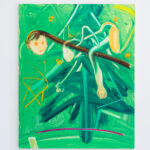
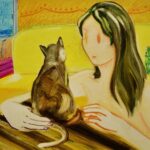
Her works often feature figures with simple expressions and a “heta-uma” (bad-but-good) aesthetic. The artist explains that these pieces largely depict her personal world: everyday occurrences, relationships with family and others, romance, and her own dreams.
Fukami’s approach, capturing the doubts and realizations of daily life, as well as the ambiguous, subtle inner movements we face as we live, while weaving in elements of fantasy, may remind viewers of Expressionist painters like Kirchner or Munch.
However, rather than positioning herself as a narrator of art history, she adopts the perspective of an ordinary person, much like Hellenistic literature that sang of love and the laws of nature. Her motto is to present the reality found within that daily existence through painting. It is precisely for this reason that Fukami’s work resonates with contemporary sensibilities, possessing the power to make us observe our own daily lives anew.